

Why you can’t control someone else’s drinking
Why you can’t control someone else’s drinking
It’s evening. On the kitchen table, a glass of water and a promise: “Starting tomorrow, I won’t drink anymore.”
She forces a smile, hoping that this time it will be different. Behind the smile, however, lies the fatigue of an endless war. She counted bottles, hid money, begged, threatened, blackmailed, cried, slept with her phone in her hand to know where her loved one was. Everything she did, she did out of love. And yet, nothing has changed. Because you can’t control the other person’s consumption.
This is the drama of the codependent – the man who loves to the point of self-destruction and who, without realizing it, becomes a prisoner of his own need to control things and people.
The Illusion of Control
Behind the desire to “save” the addict is a cocktail of painful feelings and emotions: fear of losing, shame, guilt, and helplessness. The codependent is not actually controlling anyone; he is only trying to calm his own panic. He clings to the idea that if he does enough, if he speaks convincingly enough, if he forgives again and again, then the addict will stop. But this belief is a trap. Because you cannot control the other person’s consumption.
Control becomes the form through which the codependent seeks meaning.
“If I can’t be loved, at least I can be indispensable.”
“If I can’t stop drinking, at least I can manage it.”
“If I can’t have a peaceful life, at least I can have the illusion that I can keep it under control.”
This is how the destructive dance is set up: one drinks to forget, the other controls, hoping that everything won’t fall apart. But both lose.
Why control doesn’t work
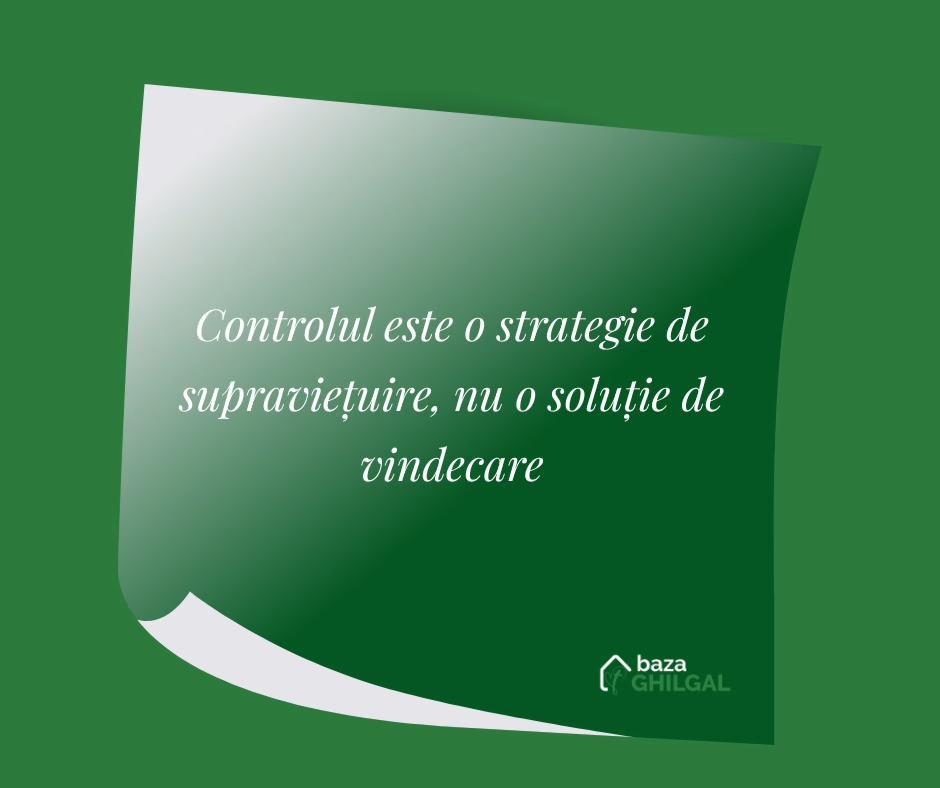
Control is a survival strategy, not a healing solution. It may work in the short term – until the next relapse, until the next broken promise. Why? Because alcoholism is not a problem of will, but a much more complex one – and it is not cured by control or morality, and even desperate love cannot cure it.
The codependent fights the effects of alcoholism, does not solve the cause. He takes the bottle out of the house, but he cannot remove the shame from the addict’s soul. He tries to convince him with arguments, but he cannot fill the inner void that demands alcohol. He protects him from the consequences, but precisely by doing so he prolongs the cycle of self-destruction.
The more the codependent controls, the more defensive, ashamed, and hidden the addict becomes. The more they try to “save” him, the deeper he sinks, because shame is the main fuel of addiction.
And while the addict drinks, the codependent dries up inside.
The silent exhaustion of the one who saves
The codependent’s life becomes a permanent state of alert. Every sound of a key in the door is an accelerated heartbeat. Every late evening is a question: “Will he ever come home?” Every promise that he will “change” is followed by a disappointment worse than the previous one.
Emotional exhaustion turns into somatizations: insomnia, tension, stomach aches, panic attacks. The mind becomes obsessed with “how to help him”, “how to convince him”, “what did I do wrong”. Until the codependent ends up not living his own life anymore.
The cruel truth is that, in trying to save the other, the codependent loses himself. He no longer knows what he feels, what he wants, who he is. He justifies his suffering by saying: “I do it out of love.” But authentic love is not to be confused with permanent sacrifice.
When love becomes a burden
In reality, the codependent and the addict are bound by a silent contract:
“I need to save you, to feel that I am worth something.” “I need to destroy myself, to keep you close.”
It is a painful but familiar bond. Sometimes, the codependent comes from a childhood where control and responsibility were the only forms of survival: he had a sick, absent, alcoholic or violent parent. He learned early that love means caring to the point of exhaustion.
Therefore, the codependent adult confuses control with love and sacrifice with loyalty. But in reality, true love doesn’t chain – it sets free. And the liberation begins when the codependent accepts the truth: you can’t quench another’s thirst when you dry up and give up on yourself.
The Liberating Truth
Abstinence cannot be imposed from the outside. Not by blackmail, not by tears, not by surveillance. Each addict must reach their own bottom and take responsibility for their own healing.
But the codependent can do something much more powerful than control them: to stop feeding the addiction through overprotection.
To say “no” without guilt.
To set healthy boundaries.
To start living their own life, not the other person’s.
This is loving detachment – a mature form of loving without destroying yourself. It means saying:
“I want your well-being, but I cannot sacrifice my peace for your war.”
“I am willing to support you, but not cover you.” “I believe in you, but I cannot live in your place.”
Paradoxically, only when the codependent gives up control does the addict have a real chance to face their own consequences.
The road to healing
The liberation of the codependent does not come overnight. It is a painful, but liberating process.
The first step is the recognition: “I have tried everything, but I can no longer continue like this.” Then comes the decision to ask for help: counseling, therapy, support groups for codependents.
In these spaces, the person learns to rebuild his identity:
to separate personal responsibility from that of the other;
to rediscover his values and joys;
to reconnect with his own soul.
Healing does not mean indifference, but freedom. It does not mean giving up on the other, but choosing yourself too. It does not mean the end of love, but the beginning of a purer love, which is not confused with control.
Control is a shadow of fear. When the codependent chooses to let go of control, they don’t lose love—they rediscover it in a healthy, free, respectful way. They no longer live to quench another’s thirst, but to quench their own burning pain, shame, and guilt.
Healing doesn’t begin when the addict stops drinking. Healing begins when the codependent stops trying to stop them.
Because true restoration doesn’t come from control, it comes from freedom. And the first step to freedom is accepting that you can’t control anything that isn’t yours—not the bottle, not the promises, not the change.
You can only control one thing: your own choice to live differently.
And in that moment, without fighting, without saving, without denying, a new beginning begins. A beginning where you no longer dance around the bottle, but look up to the light. Because freedom doesn’t mean changing the other person, but letting yourself be free.

Baza Ghilgal
BAZA GHILGAL is a dream that was born in my heart from the desire to see people restored, with healed souls, living their lives in freedom, with dignity, and knowing their value and purpose for which they were created.
News and updates
Stay connected with us and we will keep you updated on the foundation's activities. This way we can find a way to collaborate and support each other.